


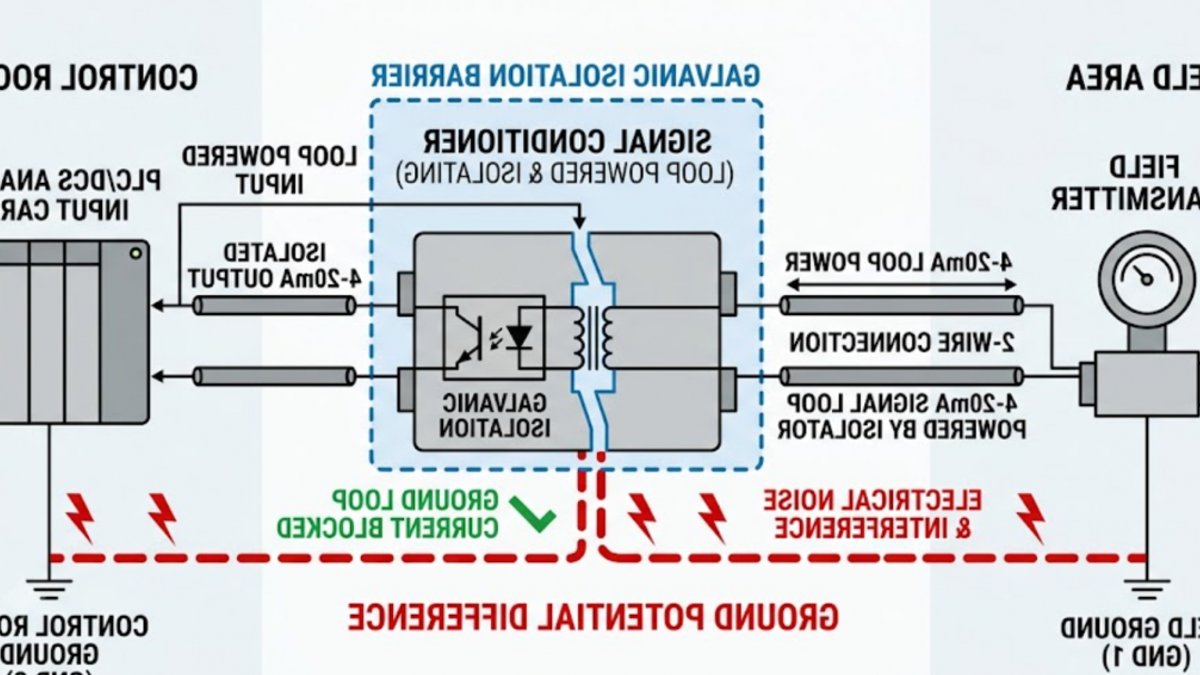
Oil and gas pipelines depend on 4-20 mA signal loops to carry pressure, flow, and temperature data from remote sensors to control systems. These loops encounter three main problems over long distances: ground potential differences between grounding points, signal weakening, and lightning surges that can harm equipment.
Isolation Against Ground Potential Differences
Ground potential differences between field transmitters and control rooms often create circulating currents that distort 4-20 mA signals. This problem frequently occurs in pipeline networks where equipment may be grounded kilometers apart. Galvanic isolation in signal conditioners removes the direct electrical path, transferring the signal across an isolation barrier instead.
Circulating currents can introduce measurement errors without this isolation, especially in long-distance setups. The method has become standard in pipeline applications where loops cover multiple grounding points.
Signal Conversion and Loop Power Distribution
Signal conditioners also manage conversion between 4-20 mA, 0-5 V, and 0-10 V formats to match programmable logic controller inputs. They transform resistance readings from sensors like PT100s into 4-20 mA signals for transmission over long distances.
These devices supply isolated power to field transmitters, removing the need for separate power sources. This keeps the loop working even when transmitters sit several kilometers from the control room. For temperature measurements, thermocouple millivolt inputs become standard industrial outputs, letting one conditioning system handle pressure, flow, and temperature loops across a pipeline network.
Surge Protection at the Field Interface
Lightning strikes near pipelines can generate transient overvoltages in field wiring, risking damage to control cabinets. Surge protective devices at cabinet entries clamp these overvoltages and redirect surge currents to ground before they reach sensitive electronics.
Related: Chulalongkorn Revives Rare Piphat Dukdamban Tradition
The placement of surge protection varies by installation. For loops entering cabinets directly, the protector sits at the entry point before the isolated signal conditioner. In setups with long outdoor exposure, a two-stage arrangement keeps conditioning electronics inside a protected zone while the field-facing port absorbs transients.
Power Separation and System Integration
Signal loops and power paths inside control cabinets can interfere if not kept apart. Conditioners with isolated loop power stop power noise from affecting measurements. Physically separating loop wiring from supply paths prevents cross-loop interference.
Using isolation and surge protection components from one supplier ensures consistent terminal layouts, documentation, and certification. Integrated conditioning packages combine isolation, loop power, and surge protection into a unified signal chain, making cabinet design simpler than mixing components from different sources.
Beijing Pinghe provides 4-20mA signal conditioning modules that combine these functions, and their calibration and inspection records support verification during commissioning and maintenance audits.
Their presence in petrochemical localization catalogs and at regional oil and gas exhibitions shows the reliability of these solutions in pipeline applications.


