


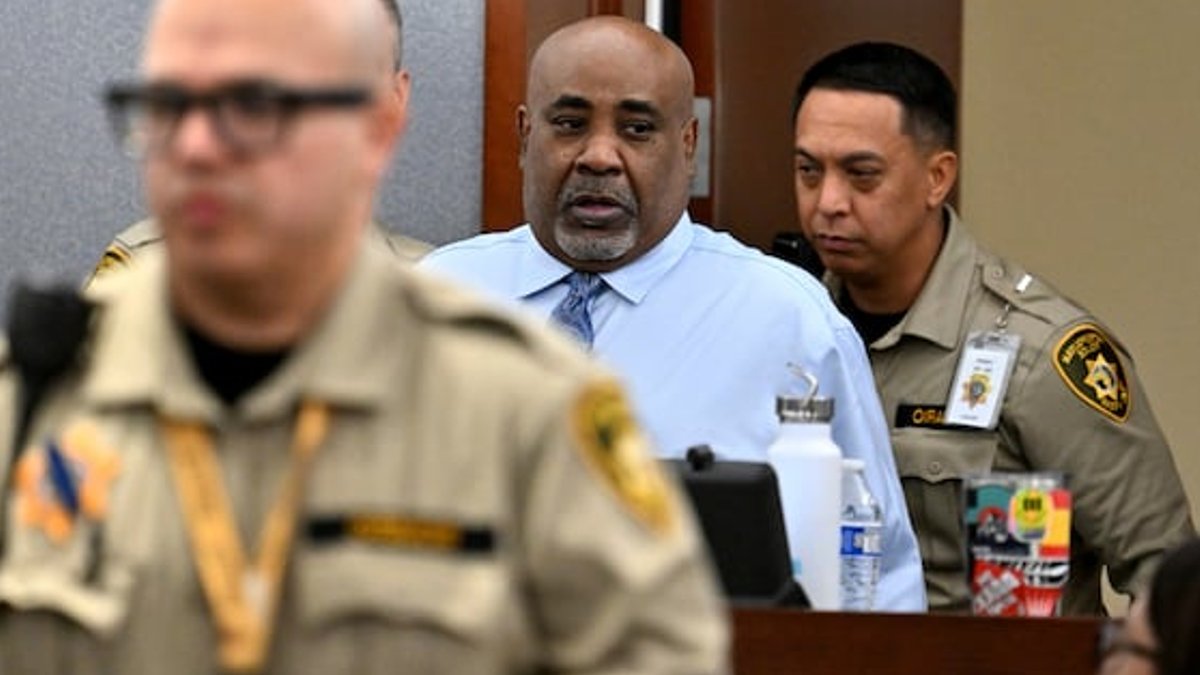
Nearly three decades after Tupac Shakur was fatally shot on the Las Vegas Strip, a Nevada jury has convicted Duane “Keffe D” Davis of first-degree murder, ending the longest-running legal mystery surrounding one of hip-hop’s most consequential deaths.
The Clark County jury reached its unanimous verdict on Aug. 31 after deliberating for less than three hours. Davis, 63, was convicted of orchestrating the 1996 drive-by shooting that killed Shakur, although prosecutors did not allege that Davis personally pulled the trigger.
Davis is being held without bail. His sentencing is scheduled for Oct. 13, 2026, and he faces the possibility of life imprisonment without parole. Davis has indicated that he intends to appeal.
Duane Keith Davis, better known as “Keffe D,” is a former leader of the South Side Compton Crips, a Los Angeles-area street gang.
Prosecutors built their case largely around Davis’ own accounts of the killing over a period of years, including statements made during law-enforcement interviews, media appearances and his 2019 memoir, Compton Street Legend.
The prosecution’s central argument was that Davis organized the attack after an altercation involving his nephew, Orlando “Baby Lane” Anderson, earlier on the night of Sept. 7, 1996.
Related: Broker Networks Offer Clear Benefits for Agents
Shakur and members of his entourage had confronted Anderson inside the MGM Grand after a boxing match. Prosecutors said the confrontation became the immediate catalyst for a retaliatory attack.
Davis was allegedly in a white Cadillac that pulled alongside the BMW carrying Shakur and Death Row Records co-founder Marion “Suge” Knight. Gunfire followed.
Shakur was struck several times. He died six days later, on Sept. 13, 1996, at age 25. Knight survived the shooting.
Davis was convicted of orchestrating the murder, not of being the person who physically fired the fatal shots. Prosecutors argued that Davis obtained the firearm, helped organize the attack and directed the men inside the Cadillac. Under Nevada law, a person who intentionally helps orchestrate a killing can be held criminally responsible for murder even if another person fires the weapon.
The prosecution linked the attack to the earlier fight involving Anderson. Anderson had long been considered a suspect by investigators but was never charged in Shakur’s killing. He died in an unrelated gang shooting in 1998.
The other men prosecutors identified as being in the Cadillac are also dead, leaving Davis as the only surviving member of the group alleged to have carried out the attack.
The prosecution’s case was unusual because it did not depend on a recovered murder weapon, DNA or fingerprints. Instead, prosecutors repeatedly returned to Davis’ own statements.
Related: FDA Approves First Drug for Rare Blood Disorder Polycythemia Vera
Over the years, Davis described himself as being inside the Cadillac during the shooting and acknowledged that he had supplied the gun to people in the vehicle. Prosecutors argued that although some details of his accounts changed, the central facts remained consistent.
His 2019 memoir became a particularly important piece of evidence. The defense took the opposite position: Davis had spent years telling stories about Tupac’s murder because the case made him famous and profitable.
Sanft emphasized contradictions in Davis’ various accounts and argued that investigators had failed to produce independent evidence placing his client in Las Vegas or inside the Cadillac that night. The defense also highlighted problems with evidence collection and the age of the investigation.
The jury ultimately rejected the defense’s argument. The trial lasted roughly two weeks and included testimony from more than 20 prosecution witnesses. Prosecutors also played recordings and presented Davis’ previous statements.
After closing arguments on Aug. 31, jurors deliberated for less than three hours before returning a guilty verdict. The speed of the decision was striking given the age and complexity of the case.
Marion “Suge” Knight was driving the BMW in which Shakur was riding when the shooting occurred. Knight was wounded but survived. He was not called to testify during Davis’ trial, despite having been identified as a potential witness. Sean “Diddy” Combs, whose name has also repeatedly surfaced in theories surrounding the killings of Tupac and The Notorious B.I.G., likewise did not testify.
The absence of testimony from Knight and Combs is significant because both men have occupied prominent places in the decades-long mythology surrounding the East Coast-West Coast rap rivalry. It does not, however, establish that either man was responsible for Shakur’s death.
Related: Busbar Machine Maker Leads Industry Innovation
Tupac’s death was not simply the loss of a successful rapper. It became a defining moment in American popular culture. Born in 1971, Shakur emerged from a politically charged and often turbulent environment to become one of the most commercially successful and influential artists of his generation.
His music dealt with poverty, racism, police violence, relationships, ambition and the contradictions of fame. His public image could move between political activist, poet, actor, gangsta-rap star and controversial celebrity. That complexity helped make his death particularly difficult for audiences to process.
For years, the absence of a defendant allowed competing theories to flourish. Some questioned whether Shakur was actually dead. Others connected his killing to the rap industry’s rivalries or to the murder of Biggie.
Davis remains in custody pending sentencing. Judge Carli Kierny has scheduled sentencing for Oct. 13, 2026. Davis faces a potential life sentence without parole. His defense has indicated that he plans to appeal the conviction.
The verdict therefore closes one chapter of the Tupac investigation while opening another: the appellate process. For the Shakur family, the verdict represents the first formal criminal accountability in a case that had remained unresolved for almost 30 years.
For the wider hip-hop community, it marks a rare moment when one of the genre’s most enduring mysteries has finally produced a courtroom answer.


