


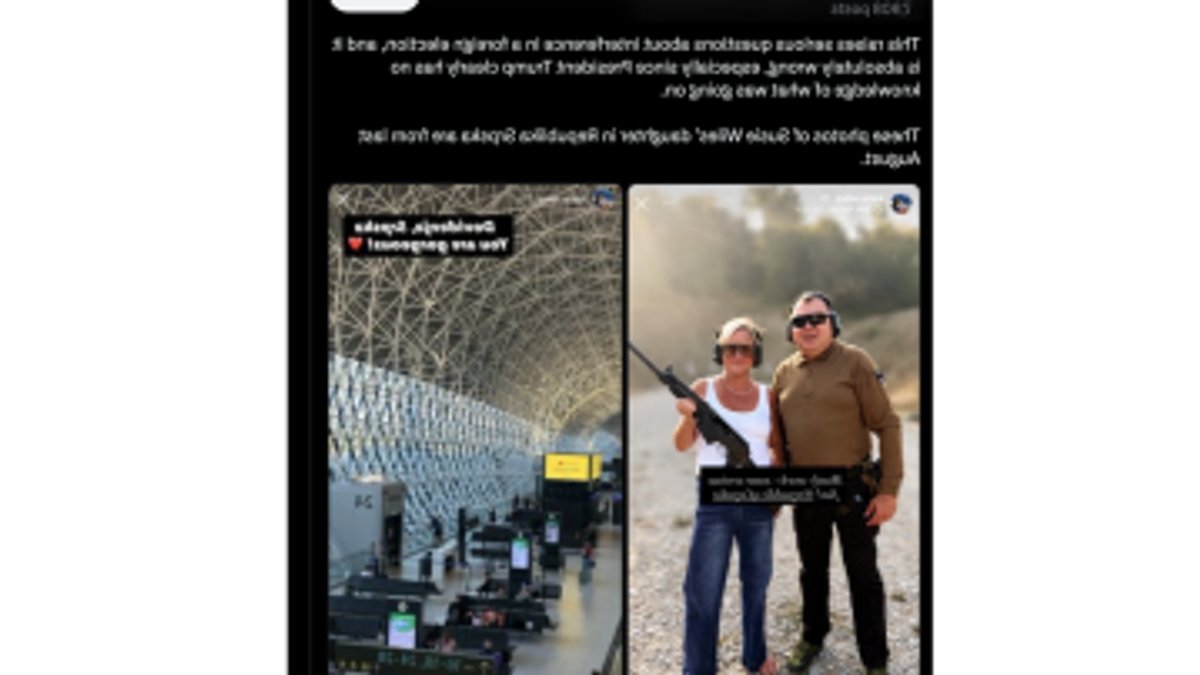
The daughter of White House Chief of Staff Susie Wiles visited Bosnia & Herzegovina’s Republika Srpska in August, an appearance that has intensified scrutiny of U.S. lobbying ties to the Serb-dominated entity. Katie Wiles, a partner at the Washington-based firm Continental Strategy, was photographed at a shooting range with Republika Srpska Interior Minister Željko Budimir, according to images shared by Albanian-American activist Evi Kokalari.
Continental Strategy confirmed that Wiles spent two days in the territory in mid-August but said her visit was tied to a separate U.S. client rather than the Republika Srpska government. “Katie Wiles visited the country in mid-August for two days with a U.S.-based company who was invited to do a feasibility study in the region,” the firm said in a statement. “Wiles provides strategic communications support to this U.S. company and has done so for over two years. Wiles has not spoken with any United States Government official regarding Srpska.”
Kokalari accused Wiles of working for months on behalf of Republika Srpska President Milorad Dodik, writing on social media that “there’s a huge conflict of interest here.” She also linked the visit to a September 21 meeting at the White House between Željka Cvijanović, described as the Serbian candidate who won the recent presidential election, and Susie Wiles. “This raises serious questions about interference in a foreign election,” Kokalari added.
Lobbying Contracts and Political Connections
Continental Strategy had a $35,000-a-month contract to lobby for Republika Srpska, according to US Foreign Agents Registration Act filings. The agreement tasked the firm with organizing meetings and cultivating relationships with senior officials in the executive and legislative branches.
The firm helped arrange a visit by Republican strategists Chris LaCivita and James Blair, who travelled to the territory ahead of the elections, Semafor reported, citing people familiar with the trip. A White House official told CBS News that Susie Wiles does not discuss work matters with her daughters. Trump later distanced himself from LaCivita and Blair, saying on Truth Social that he did not “have any idea” who they had been working for and pledging to terminate them if a conflict existed. He later described them as independent consultants who did not work for him.
Continental Strategy’s partner Alejandro Garcia, a former deputy political director for Trump’s 2016 campaign, was involved in lobbying efforts for Republika Srpska and arranging contacts with U.S. government officials, according to media reports and registration documents. The firm stated Garcia was its only employee present in Republika Srpska on election day and the only team member who had interacted with the U.S. government on the territory’s behalf.
Republika Srpska President Milorad Dodik has maintained close ties with Russian President Vladimir Putin and repeatedly challenged Bosnia’s central government. A Sarajevo court convicted him last year of failing to comply with the country’s 1995 peace accords, leading to his removal from office and a ban on holding political office. The German-based Society for Threatened Peoples has urged the European Union to impose targeted sanctions on Dodik and his associates and to investigate connections between Republika Srpska authorities and Trump-aligned figures.
The scrutiny extends to a planned gas pipeline linking Bosnia and Croatia, a project valued at more than $1.5bn. US company AAFS Infrastructure & Energy, headed by former Trump personal attorney Jesse Binnall and Joseph Flynn, brother of former Trump national security adviser Michael Flynn, was named lead developer of the project after Washington lifted sanctions against Dodik and associated individuals in October 2025. The pipeline has drawn criticism from anti-corruption watchdogs and energy experts as well as the European Union.
Transparency International Bosnia and Herzegovina warned that proposed legal amendments tied to the project “eliminates any possibility of competition” and could create a “dangerous precedent” by directly designating a private investor. A CEE Bankwatch representative said the arrangements could breach concession laws and rely on “opaque negotiations between the [Bosnian] Federation government and AAFS, raising red flags for corruption and excessive transfer of financial risks to the Federation”.
Legal and Regulatory Implications
The firm’s filings showed it organized meetings with senior officials across the executive and legislative branches, but did not include direct communication with the White House through Katie Wiles, according to the firm’s statement. The $35,000-per-month contract remained active through at least the October 4 elections, based on recent submissions to the Department of Justice.
International Reactions and Investigations
The group also requested investigations into lobbying agreements, investment projects, and potential conflicts of interest involving U.S. citizens or entities operating in the region. As of October 9, the EU had not moved to sanction Dodik, though the UK, Germany, and Austria have taken separate measures against him or individuals in his network.
Transparency International Bosnia and Herzegovina criticized proposed legal amendments tied to the $1.5 billion gas pipeline project, warning that they eliminate competition and establish a precedent for direct designation of private investors. A CEE Bankwatch representative echoed these concerns, stating that concession arrangements between the Federation government and AAFS Infrastructure & Energy could violate domestic laws and expose public finances to unnecessary risk.


